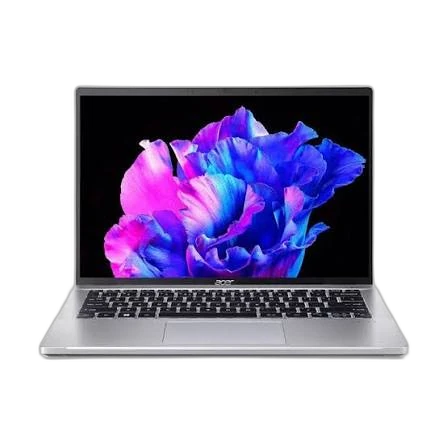
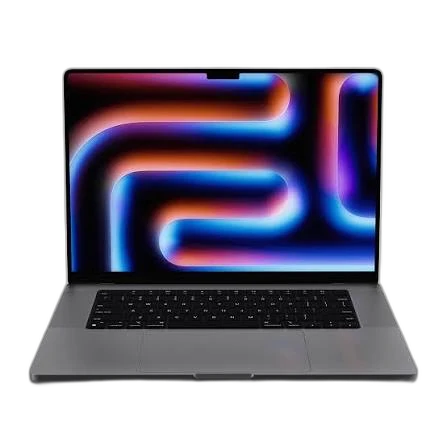
Choose Swift Go 14 if you need:
- Processor Model at Core Ultra 7 (vs M4 Max)
- Installed Memory at 16 GB (vs 48 GB)
- Storage Capacity at 512 GB (vs 1024 GB)
laptopedia
Side-by-side specification comparison of two reference models
A full side-by-side comparison of reference models Swift Go 14 and MacBook Pro 16 within the same category.
Side-by-side specification comparison of two reference models
| Specification | Swift Go 14 | MacBook Pro 16 |
|---|---|---|
| Price | Not for sale | Not for sale |
| General | ||
| Brand | Acer | Apple |
| Product Family | Swift | MacBook |
| Model | Swift Go 14 | MacBook Pro 16 |
| Launch Year | 2025 year | 2024 year |
| Form Factor | Clamshell | Clamshell |
| Laptop Category | Mainstream | Professional |
| Operating System | — | macOS |
| Operating System Architecture | 64-bit | 64-bit |
| Processor | ||
| Processor Manufacturer | Intel | Apple |
| Processor Family | Intel Core Ultra 7 | Apple M4 Max |
| Processor Model | Core Ultra 7 | M4 Max |
| Processor Generation | — | Apple M4 family |
| CPU Architecture | x86-64 | ARM64 |
| CPU Process Node | — | 3 nm |
| CPU Cores | — | 16 cores |
| Performance Cores | — | 12 cores |
| Efficiency Cores | — | 4 cores |
| AI / NPU | ||
| NPU | Yes | Yes |
| NPU Model | Intel AI Boost | Apple Neural Engine |
| Graphics | ||
| Graphics Type | Integrated | Integrated |
| GPU Manufacturer | Intel | Apple |
| GPU Model | — | Apple M4 Max 40-core GPU |
| VRAM Capacity | 0 GB | 0 GB |
| VRAM Type | Shared system memory | Shared system memory |
| Maximum External Displays | — | 4 displays |
| Maximum External Resolution | — | Up to 8K @ 60Hz or 4K @ 240Hz |
| Memory | ||
| Installed Memory | 16 GB | 48 GB |
| Maximum Memory | — | 128 GB |
| Memory Type | — | Unified Memory |
| Memory Form Factor | — | On-package |
| Memory Slots | — | 0 slots |
| Memory Slots Used | — | 0 slots |
| Memory Upgradeable | — | No |
| Storage | ||
| Primary Storage Type | SSD | SSD |
| Storage Capacity | 512 GB | 1024 GB |
| Installed Storage Drives | 1 drives | 1 drives |
| Card Reader | — | Yes |
| Card Reader Formats | — | SDXC |
| Card Reader Standard | — | SDXC |
| Display | ||
| Display Size | — | 16.2 inch |
| Display Resolution | — | 3456 x 2234 |
| Resolution Class | — | 3.5K |
| Display Technology | — | Mini-LED |
| Panel Type | — | Liquid Retina XDR |
| Refresh Rate | — | 120 Hz |
| Variable Refresh Rate | — | Yes |
| VRR Range | — | ProMotion up to 120 Hz; fixed 47.95–60 Hz Hz |
| Display Brightness | — | 1000 nits |
| Peak HDR Brightness | — | 1600 nits |
| DCI-P3 Color Gamut | — | 100 % |
| Color Depth | — | 10-bit |
| Contrast Ratio | — | 1000000:1 |
| HDR Support | — | Yes |
| Dolby Vision | — | Yes |
| Adaptive Sync Technology | — | ProMotion |
| Camera & Biometrics | ||
| Webcam Resolution | — | 12MP |
| Fingerprint Reader | — | Yes |
| Fingerprint Reader Location | — | Keyboard (Touch ID) |
| Camera Features | — | Center Stage; Desk View; computational video |
| Audio | ||
| Speaker Configuration | — | 6-speaker system |
| Audio Technology | — | Spatial Audio, Dolby Atmos |
| Microphone Configuration | — | 3-mic studio-quality array |
| Audio Jack | — | Yes |
| Keyboard & Input | ||
| Keyboard Type | — | Backlit Magic Keyboard |
| Keyboard Backlight | — | Yes |
| Keyboard RGB Zones | — | — |
| Touchpad Type | — | Force Touch |
| Wireless & Networking | ||
| Wi-Fi Standard | — | Wi-Fi 6E |
| Wi-Fi IEEE Standard | — | 802.11ax |
| Wi-Fi Bands | — | 2.4 GHz, 5 GHz, 6 GHz |
| Bluetooth Version | — | 5.3 |
| WWAN | — | No |
| Ports & Expansion | ||
| USB Type-A Port Count | — | 0 ports |
| USB Type-A Specifications | — | — |
| USB Type-C Port Count | — | 3 ports |
| USB Type-C Specifications | — | Thunderbolt 5 / USB4 / charging / DisplayPort |
| USB4 Port Count | — | 3 ports |
| USB4 Speed | — | 120 Gbps |
| Thunderbolt Port Count | — | 3 ports |
| Thunderbolt Version | — | Thunderbolt 5 |
| HDMI Port Count | — | 1 ports |
| DisplayPort Output | — | DisplayPort over USB-C |
| RJ-45 Port Count | — | 0 ports |
| 3.5 mm Audio Combo Port Count | — | 1 ports |
| SD Card Slot Count | — | 1 ports |
| microSD Card Slot Count | — | 0 ports |
| Smart Card Reader | — | No |
| Battery & Power | ||
| Battery Capacity | — | 100 Wh |
| Battery Chemistry | — | Li-polymer |
| Battery Life | — | 21 hours |
| Battery Life Test Method | — | Video streaming |
| Fast Charging | — | Yes |
| Fast Charge Level | — | 50 % |
| Fast Charge Time | — | 30 min |
| Power Adapter | — | 140 W |
| Power Connector | — | MagSafe 3 |
| USB-C Charging | — | Yes |
| Maximum USB-C Charging Power | — | 140 W |
| Dimensions & Build | ||
| Width | — | 355.7 mm |
| Depth | — | 248.1 mm |
| Thickness | — | 16.8 mm |
| Weight | — | 2.15 kg |
| Chassis Material | — | Aluminum |
| Lid Material | — | Aluminum |
| Base Material | — | Aluminum |
| Security & Manageability | ||
| Secure Boot | — | Yes |
| Sensors | ||
| Ambient Light Sensor | — | Yes |
| Certifications & Sustainability | ||
| ENERGY STAR | — | ENERGY STAR |
| EPEAT | — | EPEAT Gold (US and Canada) |
| RoHS Compliance | — | Yes |
| Recycled Materials | — | 40% recycled content; 100% recycled aluminum enclosure |
| Product Carbon Footprint | — | 303 kg CO2e |
| Environment & Warranty | ||
| Warranty | — | 1 years |
| Warranty Type | — | Apple One-Year Limited Warranty |
Swift Go 14 and MacBook Pro 16 share specifications such as Form Factor (Clamshell), Operating System Architecture (64-bit), NPU (Yes), Graphics Type (Integrated).
The main differences: Processor Model (Swift Go 14: Core Ultra 7, MacBook Pro 16: M4 Max); Installed Memory (Swift Go 14: 16 GB, MacBook Pro 16: 48 GB); Storage Capacity (Swift Go 14: 512 GB, MacBook Pro 16: 1024 GB).
Swift Go 14 may suit users who need its differing values, while MacBook Pro 16 benefits those who need its paired strengths. Review the specs table above before deciding.