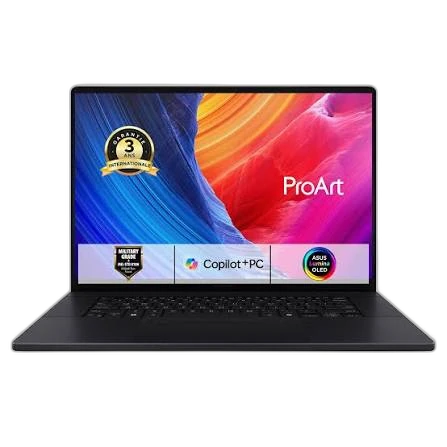
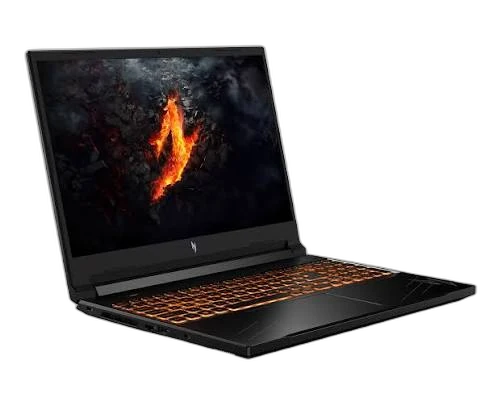
Choose ProArt P16 if you need:
- Processor Model at AMD Ryzen AI 9 HX 370 (vs AMD Ryzen 7 260)
- GPU Model at RTX 5080 (vs RTX 5050)
- Installed Memory at 64 GB (vs 16 GB)
- Storage Capacity at 2048 GB (vs 512 GB)
laptopedia
Side-by-side specification comparison of two reference models
A full side-by-side comparison of reference models ProArt P16 and Nitro V 16 within the same category.
Side-by-side specification comparison of two reference models
| Specification | ProArt P16 | Nitro V 16 |
|---|---|---|
| Price | Not for sale | Not for sale |
| General | ||
| Brand | ASUS | Acer |
| Product Family | ProArt | Nitro |
| Model | ProArt P16 | Nitro V 16 |
| Model Number | H7606WW | ANV16-42-R1FJ |
| Part Number / SKU | — | NH.QYWEK.007 |
| Launch Year | 2025 year | 2025 year |
| Form Factor | Clamshell | Clamshell |
| Laptop Category | Professional | Gaming |
| Color | Nano Black | Black |
| Operating System | Windows 11 Home | Windows 11 Home |
| Operating System Architecture | 64-bit | 64-bit |
| Processor | ||
| Processor Manufacturer | AMD | AMD |
| Processor Family | AMD Ryzen AI 9 | AMD Ryzen 7 |
| Processor Model | AMD Ryzen AI 9 HX 370 | AMD Ryzen 7 260 |
| Processor Generation | Ryzen AI 300 Series | Ryzen 200 Series |
| CPU Architecture | x86-64 | x86-64 |
| CPU Process Node | 4 nm | 4 nm |
| CPU Cores | 12 cores | 8 cores |
| Performance Cores | 4 cores | — |
| Efficiency Cores | 8 cores | — |
| CPU Threads | 24 threads | 16 threads |
| CPU Base Clock | 2 GHz | 3.8 GHz |
| CPU Max Boost Clock | 5.1 GHz | 5.1 GHz |
| L2 Cache | 12 MB | 8 MB |
| L3 Cache | 24 MB | 16 MB |
| Processor Base Power | 28 W | 45 W |
| Maximum Processor Power | 54 W | 54 W |
| AI / NPU | ||
| NPU | Yes | Yes |
| NPU Model | AMD XDNA | AMD Ryzen AI |
| NPU Performance | 50 TOPS | 16 TOPS |
| Platform AI Performance | 80 TOPS | 38 TOPS |
| Copilot+ PC | Yes | — |
| Graphics | ||
| Graphics Type | Discrete | Discrete |
| GPU Manufacturer | NVIDIA | NVIDIA |
| GPU Model | RTX 5080 | RTX 5050 |
| GPU Architecture | Blackwell | Blackwell |
| VRAM Capacity | 16 GB | 8 GB |
| VRAM Type | GDDR7 | GDDR7 |
| GPU TGP | 120 W | 95 W |
| MUX Switch | — | Yes |
| Maximum External Displays | 4 displays | 4 displays |
| Memory | ||
| Installed Memory | 64 GB | 16 GB |
| Maximum Memory | 64 GB | 32 GB |
| Memory Type | LPDDR5X | DDR5 |
| Memory Speed | 7500 MT/s | 5600 MT/s |
| Memory Form Factor | Onboard | — |
| Memory Slots | 0 slots | — |
| Memory Slots Used | 0 slots | — |
| Memory Upgradeable | No | Yes |
| Memory Channels | Dual-channel | Dual-channel |
| Storage | ||
| Primary Storage Type | SSD | SSD |
| Storage Capacity | 2048 GB | 512 GB |
| Storage Interface | PCIe NVMe | PCIe NVMe 4.0 |
| Storage PCIe Generation | PCIe 4.0 | PCIe 4.0 |
| Storage Form Factor | M.2 2280 | M.2 |
| Installed Storage Drives | 1 drives | 1 drives |
| Maximum Storage Drives | 2 drives | — |
| M.2 Storage Slots | 2 slots | — |
| Card Reader | Yes | Yes |
| Card Reader Formats | SD | microSD |
| Card Reader Standard | SD Express 7.0 | — |
| Display | ||
| Display Size | 16 inch | 16 inch |
| Display Resolution | 3840 x 2400 | 1920 x 1200 |
| Resolution Class | 4K | WUXGA |
| Display Technology | OLED | LCD |
| Panel Type | OLED | IPS |
| Touchscreen | Yes | — |
| Pen Support | Yes | — |
| Refresh Rate | 120 Hz | 180 Hz |
| Variable Refresh Rate | Yes | — |
| Peak HDR Brightness | 1600 nits | — |
| DCI-P3 Color Gamut | 100 % | — |
| Color Accuracy | 1 Delta E | — |
| Color Depth | 1.07 billion colors | 8-bit |
| Contrast Ratio | 1,000,000:1 | — |
| Aspect Ratio | 16:10 | 16:10 |
| Response Time | 0.2 ms | — |
| Display Finish | Anti-reflective | Anti-glare |
| HDR Support | Yes | — |
| VESA DisplayHDR Certification | DisplayHDR True Black 1000 | — |
| Dolby Vision | Yes | — |
| Screen-to-Body Ratio | 88 % | — |
| Low Blue Light Certification | 70% less harmful blue light | — |
| Camera & Biometrics | ||
| Webcam Resolution | FHD | 1080p FHD |
| IR Camera | Yes | — |
| Camera Privacy Shutter | — | Yes |
| Windows Hello Face | Yes | — |
| Presence Detection | Yes | — |
| Camera Features | ASUS AiSense camera; Adaptive Lock; Adaptive Dimming | FHD camera with privacy shutter |
| Audio | ||
| Speaker Configuration | — | 2 speakers |
| Audio Technology | Realtek ALC285 | — |
| Microphone Configuration | Built-in array microphone | Built-in microphone |
| Audio Jack | Yes | — |
| Keyboard & Input | ||
| Keyboard Type | Backlit Chiclet Keyboard | Backlit keyboard with amber lighting and status indicators |
| Keyboard Backlight | Yes | Yes |
| Keyboard RGB Zones | — | — |
| Key Travel | 1.7 mm | — |
| Copilot Key | Yes | — |
| Touchpad Type | Precision touchpad with DialPad | Microsoft Precision Touchpad |
| Wireless & Networking | ||
| Wi-Fi Standard | Wi-Fi 7 | Wi-Fi 6E |
| Wi-Fi IEEE Standard | 802.11be | IEEE 802.11ax |
| Wi-Fi Bands | Tri-band | 2.4 / 5 / 6 GHz |
| Wi-Fi Spatial Streams | 2x2 | 2x2 |
| Wi-Fi Module | MediaTek MT7925B22M | 2x2 AX+BT 6E |
| Bluetooth Version | 5.4 | 5.3 or above |
| Ethernet | — | Yes |
| Ethernet Speed | — | Gigabit Ethernet |
| WWAN | No | No |
| Ports & Expansion | ||
| USB Type-A Port Count | 2 ports | 3 ports |
| USB Type-A Specifications | USB 3.2 Gen 2 Type-A | 1x USB 3.2 Gen 1 + 2x USB 3.2 Gen 2 |
| USB Type-C Port Count | 2 ports | 1 ports |
| USB Type-C Specifications | 1x USB4 Gen 3 Type-C 40Gbps with display/PD; 1x USB 3.2 Gen 2 Type-C 10Gbps with display/PD | USB4 Type-C |
| USB4 Port Count | 1 ports | 1 ports |
| USB4 Speed | 40 Gbps | — |
| Thunderbolt Port Count | 0 ports | 0 ports |
| HDMI Port Count | 1 ports | 1 ports |
| HDMI Version | HDMI 2.1 FRL | — |
| DisplayPort Output | DisplayPort via USB-C | No |
| RJ-45 Port Count | 0 ports | 1 ports |
| 3.5 mm Audio Combo Port Count | 1 ports | — |
| SD Card Slot Count | 1 ports | 0 ports |
| microSD Card Slot Count | 0 ports | 1 ports |
| Smart Card Reader | No | No |
| Security Lock Slot | — | Yes |
| Internal PCIe Slots | 2 M.2 slots: 1x M.2 2280 PCIe 4.0 x4; 1x M.2 2280 PCIe 4.0 x2 | — |
| Battery & Power | ||
| Battery Capacity | 90 Wh | 76 Wh |
| Battery Cells | 4 cells | 4 cells |
| Battery Chemistry | Li-ion | Lithium-ion |
| Battery Life | — | 7.5 hours |
| Battery Life Test Method | — | Video playback test (WUXGA + SSD) |
| Power Adapter | 240 W | 100 W |
| Power Connector | Rectangle DC-in | — |
| USB-C Charging | Yes | — |
| Maximum USB-C Charging Power | 100 W | — |
| Dimensions & Build | ||
| Width | 354.9 mm | 360 mm |
| Depth | 246.9 mm | 275.6 mm |
| Thickness | 18.3 mm | 24.5 mm |
| Weight | 1.95 kg | 2.44 kg |
| Chassis Material | Aluminum top case | — |
| MIL-STD Testing | MIL-STD-810H | — |
| Security & Manageability | ||
| TPM | Firmware TPM | Firmware TPM |
| Microsoft Pluton | Yes | Yes |
| BIOS / UEFI Password Support | — | Yes |
| Smart Card Support | — | No |
| Sensors | ||
| Ambient Light Sensor | Yes | — |
| Color / Color Temperature Sensor | Yes | — |
| Certifications & Sustainability | ||
| ENERGY STAR | ENERGY STAR 8.0 | — |
| RoHS Compliance | Yes | — |
| Product Carbon Footprint | 308 kg CO2e | — |
| Environment & Warranty | ||
| Warranty | — | 1 years |
| Warranty Type | — | Carry-in (International Travelers Warranty) |
ProArt P16 and Nitro V 16 share specifications such as Display Size (16 inch), Launch Year (2025 year), Form Factor (Clamshell), Operating System (Windows 11 Home).
The main differences: Processor Model (ProArt P16: AMD Ryzen AI 9 HX 370, Nitro V 16: AMD Ryzen 7 260); GPU Model (ProArt P16: RTX 5080, Nitro V 16: RTX 5050); Installed Memory (ProArt P16: 64 GB, Nitro V 16: 16 GB); Storage Capacity (ProArt P16: 2048 GB, Nitro V 16: 512 GB).
ProArt P16 may suit users who need its differing values, while Nitro V 16 benefits those who need its paired strengths. Review the specs table above before deciding.